
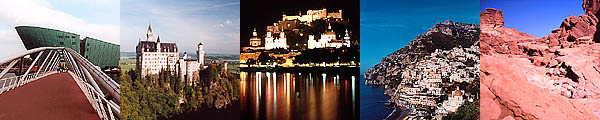
HOLLAND
GERMANY
AUSTRIA
ITALY
TUNISIA
Nights were spent in italicized locations.
2000 October 23 : Monday
| Sep 20 |
Portland |
| Sep 21 | Charles
de Gaulle, Delft |
| Sep 22 | Amsterdam,
Delft |
| Sep 23 | Delft,
Rotterdam, Stromberg |
| Sep 24 | Dinkelsbühl,
Munich |
| Sep 25 | Schloss
Neuschwanstein, Munich |
| Sep 26 | Munich,
Solnhofen, Rothenburg ob der Tauber |
| Sep 27 | Rothenburg
ob der Tauber, Salzburg |
| Sep 28 | Berchtesgaden,
Salzburg |
| Sep 29 | Salzburg,
Vienna |
| Sep 30 | Vienna,
night train |
| Oct 01 | Venice |
| Oct 02 | Venice,
Verona, Florence |
| Oct 03 | Florence,
Pisa, Cinqe Terre (Monterosso) |
| Oct 04 | Cinqe
Terre: Riomaggiore, Manarola, Corniglia, Vernazza, Monterosso |
| Oct 05 | Cinqe
Terre (Monterosso), Rome: Coliseum, Forum |
| Oct 06 | Palestrina,
Rome: St. Peter's, Vatican Museum |
| Oct 07 | Rome:
Pantheon, Spanish Steps, Trevi Fountaine, Palatine Hill, etc. |
| Oct 08 | Santa
Maria Capua Vetere, Caserta, Naples |
| Oct 09 | Pozzouli,
Santa Maria Capua Vetere, Caserta, Naples |
| Oct 10 | Positano |
| Oct 11 | Mt.
Vesuvius, Pompeii, Positano |
| Oct 12 | Paestum,
Positano |
| Oct 13 | Positano,
Amalfi, Ravello, night train |
| Oct 14 | Taormina |
| Oct 15 | Catania,
Palermo, Trapani |
| Oct 16 | all-day
ferry, Tunis |
| Oct 17 | Tunis,
Thuburbo Majus, Zaghouan, Kairouan |
| Oct 18 | Kairouan |
| Oct 19 | Mactaris,
Sufetula, Kairouan |
| Oct 20 | Kairouan,
Monastir, El Jem, Houmt Souk |
| Oct 21 | Ajim,
Medenine, Ksar Hadada, Tataouine |
| Oct 22 | Ksar
Ouled Soltane, Douirat, Chenini, Foum Tataouine, Matmata |
| Oct 23 | Matmata,
Douz, Chott El D'Jerid, Tozeur |
| Oct 24 | Sidi
Bouhlel, Chott El Gharsa, Tozeur |
| Oct 25 | Chebika,
Tamerza, Mides, Seldja Gorge, Tozeur |
| Oct 26 | Sidi
Bouhlel, Chott El D'Jerid, Tozeur |
| Oct 27 | Chott
El Gharsa, Chott El D'Jerid, Sidi Bouhlel, Tozeur |
| Oct 28 | Chott
El D'Jerid, Sidi Bouhlel, Tozeur |
| Oct 29 | Dougga,
Sidi Bou Said, La Marsa |
| Oct 30 | La Marsa,
Rome |
| Oct 31 | Rome,
Atlanta, Portland |
|
|
|
| ©2001-2008 by Mitch Darby - all rights reserved. | |
MATMATA
Matmata is remarkable in that much of it is underground. A thousand years ago, the Berber tribes that inhabited it and several neighboring villages, dug down into the soft tufa to escape the desert heat as well as their enemies. Large pits with rooms cut into the sides of them became their homes. Today, several hotels have been fashioned by joining several of these dwellings together. The most famous of them is the Hotel Sidi Driss. I had known since the late '70's that the interior scenes of Luke Skywalker's desert home had been shot here. More recently, I had learned last August that George Lucas and his Episode II film crew were scheduled to start shooting here in September. I hoped that this fact would not jeopardize my October pilgrimage. I was pleased to discover that it had not.
After booking a room for the night, I followed the previously mentioned sign to the largest pit. Walking out into the sunlight I was amazed to find that it had been completely redecorated by the film crew during their visit a few weeks prior. Nearly every detail matched my 1977 stills. The only things missing were the vaporators that would have been in the center of the courtyard (most likely the crew took these with them when they left). Inspecting the décor, I found that most of it was made of painted plywood and metal heating ducts. Pool filters and PVC pipe comprised some of the machinery that was still attached to the walls. Simple pieces of molded plastic with small squares of reflective tape had been attached to the walls to simulate "door actuators."
Since 1977, the town and hotel have experienced a boon in tourism. So much so, that the only bar in town - located within the Hotel Sidi Driss - has been renamed the "Mos Eisley Cantina." Many of the guidebooks further the legend by stating that the Cantina scene was filmed here. In reality it was filmed on a London sound stage and then re-shot in Los Angeles several months later. Regardless, I was charged by what I saw in Matmata. I even struck up a friendship with an Englishman named Greg, about my age, who was also in Tunisia alone on vacation. The next day he accompanied me as I drove northwest to Tozeur.
TOZEUR
Tozeur is an oasis town - a narrow band of palm trees, camels, and Land Cruisers that is sandwiched between Tunisia's two great salt flats: the expansive Chott El Gharsa to the north and to the south, the seemingly endless Chott El D'Jerid. We arrived in town in mid-afternoon. After setting up in a hotel and getting some lunch, we decided to visit a few of the nearby STAR WARS locations.
The road west out of Tozeur continues on to the smaller oasis town of Nefta and beyond that, stretches into civil war-torn Algeria. We stopped short of Algeria, instead turning off onto a sandy road and parking at the edge of a few sand dunes. A small souvenir stand was set up and as Greg and I ventured out onto the sand, we were immediately tailed by several Tunisian youths leading camels. It was clear that they wanted us to hire their camels. Greg casually waved them off with "Non, merci," but they followed anyway. The wind was really blowing that day and with the swirling sand and dust, visibility had been poor ever since we left Matmata. We watched as our footsteps disappeared nearly as quickly as we made them.
Halfway to the largest dune, we noticed eight small figures rushing down a side dune towards our position. A few minutes later and we were being pestered by Berber children trying to sell us sand roses and cloth dolls. "Non, merci," we replied with a smile and kept walking. The children joined the others in following us. Within five minutes of parking the car, our procession reached the crest of the highest dune. This was the location of the escape pod landing at the beginning of the original film. It was also where C-3PO had walked by a huge skeleton prior to being picked up by the Jawas. I had known from one of the few biographies on George Lucas that the skeleton had been left in the sand after filming was completed. I had also known that it was still here in 1995, as pictures taken of it at that time had been published in the Star Wars Insider. Since that time, other fans and locals interested in making a quick Dinar have collected the remainder of the fiberglass dinosaur replicas. The only bits of plastic we found residing in those dunes were the ever-present non-refundable water bottles. A few "Non, mercies" later we were back in the car and headed across the Tunisia-Algeria road towards the Chott El Jerid.
THE CHOTT EL JERID
Under the intense African sun, the small silhouettes danced and shimmered above the endless horizon. A mirage. Slowly, the shapes congealed into the forms of several reconstructed craters and the domed entrance to the Lars Homestead. The exterior of Luke Skywalker's house originally had been constructed on the Chott in 1977. In 1994 it had been reported that all that was left were a series of low, heavily eroded crater rings that were barely discernible from the rest of the flat landscape. Armed with satellite co-ordinates of the location, we let the GPS guide us to the spot. Greg was flabbergasted! I had known from an Internet report the month before that the site had been rebuilt, but chose to keep it to myself in order to see his reaction.
We braved the wind to take a few photos and inspect the construction: a remarkably strong plywood frame overlain with chicken wire and plaster. As the sun dripped towards the horizon, Greg insisted on getting a photo of me overlooking the larger crater as Luke does in film. Content, we drove back to Tozeur.
CHOTT EL GHARSA & OUNG JEMEL
The next day, the wind was still blowing, but we decided to see if we could find the Episode I sets. Like the Lars Homestead set, I had acquired the satellite coordinates and the approximate location. Unfortunately, I only had the journey's end and not its beginning. Together, Greg and I drove the roads in and around Tozeur looking for a sign or other clue to point us in the right direction. By early afternoon, we realized we were at a loss.
Arriving back at our hotel, we bumped into several 30-something Canadian tourists. Sitting in the lobby, they looked with through my collection of stills. However, they only had a passing interest and when the rest of their party arrived to go to lunch, they went. In their absence, a tall Arab man with designer sunglasses approached and asked if he could have a look. He introduced himself as Kamel and told us that he ran a Land Cruiser safari business and could take us to the sets the next day for 30 Dinars each. Suspicious and not ready to give up our search just yet, we told him we would consider his offer and get back to him later.
That afternoon, Greg decided to pass on the rest of the adventure and instead checked out of the hotel in order to catch the next shared taxi to El Kef in the northern part of the country. Having now lost my French translator, I was more inclined to accept Kamel's offer. He did, after all, speak English. So, the next day I met up with him...
The Hotel Sidi Driss was the inspiration and location of Luke Skywalker's home in STAR WARS.

01) MATMATA: THE HOTEL SIDI DRISS | A
few weeks before I left Portland, I read Internet reports that the hotel
had been redecorated by the Episode II crew. Sure enough...

02) MATMATA: THE HOTEL SIDI DRISS | The
largest of the five "pits" that comprise the hotel was redecorated
almost exactly as it had been over 20 years prior.

03) MATMATA: THE HOTEL SIDI DRISS | Some
of the set dressing from the original movie has survived intact. This
arch is such an example.

04) MATMATA: THE HOTEL SIDI DRISS | The
ceiling of this dining room is visible in the 1977 film. The design you
see is a recreation/restoration of the one originally seen in the film
(below).
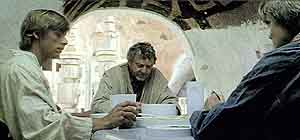
|
From
STAR WARS : EP. IV : A NEW HOPE
Luke's Aunt Beru, a warm, motherly woman, fills a pitcher with blue fluid from a refrigerated container in the well-used kitchen. She puts the pitcher on a tray with some bowls of food and starts for the dining area. Luke sits with his Uncle Owen before a table covered with steaming bowls of food as Aunt Beru carries in a bowl of red grain. LUKE:
You know, I think that R2 unit we bought might have been stolen. Owen is greatly alarmed at the mention of his name, but manages to control himself. LUKE: I thought he might have meant old Ben. Do you know what he's talking about? Well, I wonder if he's related to Ben. Owen breaks loose with a fit of uncontrolled anger. OWEN:
That old man's just a crazy old wizard. Tomorrow I want you
to take that R2 unit into Anchorhead and have its memory flushed.
That'll be the end of it. It belongs to us now. |
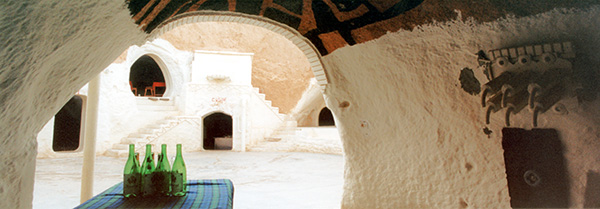
05) MATMATA: THE HOTEL SIDI DRISS | A
similar shot. Sharp eyes will notice that the element on the wall at the
right differs from the one seen in the original film.

06) MATMATA: THE HOTEL SIDI DRISS | The
ornament on the stairs is also "left over" from the original
film.
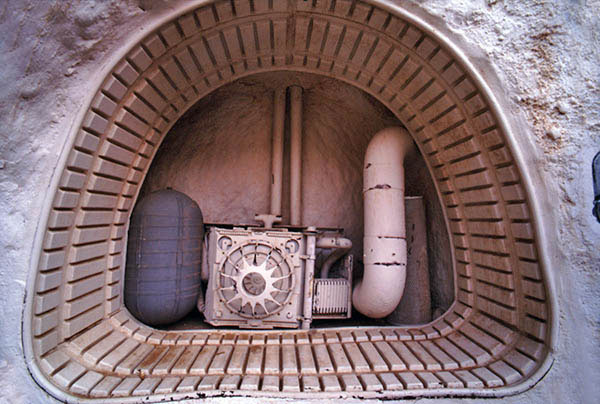
07) MATMATA: THE HOTEL SIDI DRISS | Rubber
molding and PVC are the main ingrediants of this recipe.
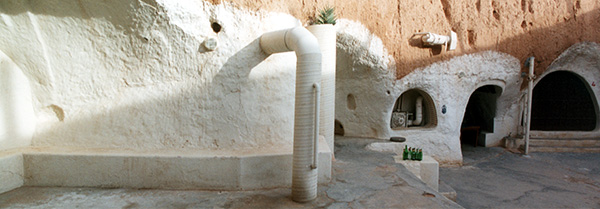
08) MATMATA: THE HOTEL SIDI DRISS | Add
heating duct for spice.
|
From
STAR WARS : EP. IV : A NEW HOPE
Morning slowly creeps into the sparse but sparkling oasis of the open courtyard. The idyll is broken be the yelling of Uncle Owen, his voice echoing throughout the homestead. OWEN: Luke? Luke? Luke? Where could he be loafing now! |

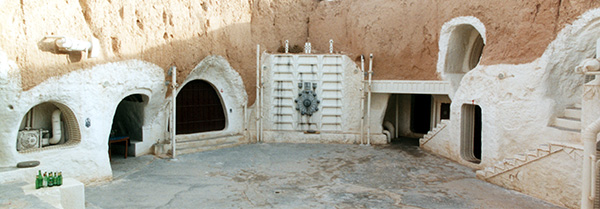
09) MATMATA: THE HOTEL SIDI DRISS | Asside
from a few stolen buttons, the vaporators were the only pieces of the
set that were missing. Presumably they were needed elsewhere.
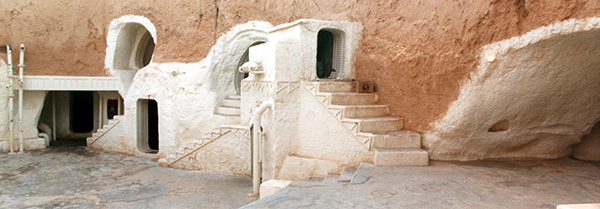
10) MATMATA: THE HOTEL SIDI DRISS | I'm
standing a few steps up on the raised part of the courtyard. The passage
on the far left connects this "pit" to the next one.

11) MATMATA: THE HOTEL SIDI DRISS | Looking
down from the rim. The oval door (up the steps at the right) is the entrance
to the bar - which is nicknamed "the Mos Eisley Cantina." Over
the years many guidebooks have stated that the hotel was used as a shooting
location for the cantina. However, all the cantina shots
in the film were done on a soundstage in London and then later reshot
on a soundstage in LA.
|
From
STAR WARS : EP. IV : A NEW HOPE
The Jawas mutter gibberish as they busily line up their battered captives, including Artoo and Threepio, in front of the enormous Sandcrawler, which is parked beside a small homestead consisting of three large holes in the ground surrounded by several tall moisture vaporators and one small adobe block house. The Jawas scurry around fussing over the robots, straightening them up or brushing some dust from a dented metallic elbow. The shrouded little creatures smell horribly, attracting small insects to the dark areas when their mouths and nostrils should be. Out of the shadows of a dingy side-building limps Owen Lars, a large burly man in his mid-fifties. His reddish eyes are sunken in a dust-covered face. As the farmer carefully inspects each robot, he is closely followed by his slump-shouldered nephew, Luke Skywalker. One of the vile little Jawas walks ahead of the farmer spouting an animated sales pitch in a queer, unintelligible language. A voice calls out from one of the huge holes that form the homestead. Luke goes over to the edge and sees his Aunt Beru standing in the main courtyard. BERU:
Luke, tell Owen that if he gets a translator to be sure it speaks
Bocce. |
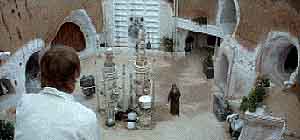

12) MATMATA: THE HOTEL SIDI DRISS | You'll
notice in the film that the courtyard is shown from the lip down. That's
because in the film, everything above the lip was shot 150 miles away
on the Chott El Jerid salt flat.

13) MATMATA: THE HOTEL SIDI DRISS | Front
door .
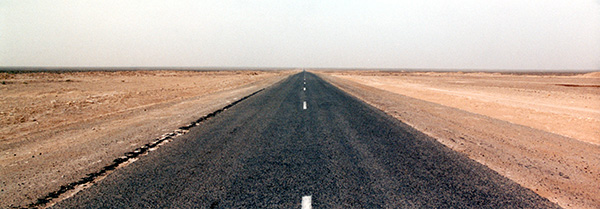
14) SOUTHERN TUNISIA | On
the road from Matmata to Douz.

15) DOUZ | This
castle rises from the sand on the outskirts of Douz.
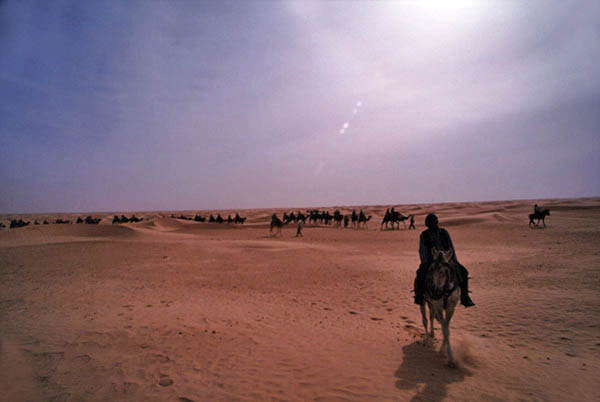
16) DOUZ | After
photographing #15, I turned around to find this caravan. The Arab on the
horse, came to ask me if I wanted to join the other tourists.

17) DOUZ | It's
not a real castle. It was built for the French film LE CIEL SOUS LE DESERT
(so says the sign at the right of the door). It's not very large either.
The door is human scale.

18) DOUZ | Note
the figure looking over the ramparts. He was in charge of the set and
didn't like his photo to be taken (he'd hide). I managed to sneak a shot
while he was preoccupied with the donkeys.

19) DOUZ | Closeup
view.

20) DOUZ | I'd
love to see the film to see how the set was shot.

21) DOUZ | Set constrution: metal scaffolding,
wood planks, plaster.

22) DOUZ | This photo comes from a Tunisia
guidebook. I discovered upon my return home that several other sets were
also built in Douz for another French film called PEUT-ÊTRE (directed
by Cedric Klapisch). Had I known about them, I would have looked for them
as well.

23) CHOTT EL D'JERID | Crossing the Chott
El D'Jerid. By the way, this is a typical Tunisian road. If you happen
to find the shoulders, let me know...