HOLLAND
GERMANY
AUSTRIA
ITALY
TUNISIA
Nights were spent in italicized locations.
2000 October 05 : Thursday
| Sep 20 |
Portland |
| Sep 21 | Charles
de Gaulle, Delft |
| Sep 22 | Amsterdam,
Delft |
| Sep 23 | Delft,
Rotterdam, Stromberg |
| Sep 24 | Dinkelsbühl,
Munich |
| Sep 25 | Schloss
Neuschwanstein, Munich |
| Sep 26 | Munich,
Solnhofen, Rothenburg ob der Tauber |
| Sep 27 | Rothenburg
ob der Tauber, Salzburg |
| Sep 28 | Berchtesgaden,
Salzburg |
| Sep 29 | Salzburg,
Vienna |
| Sep 30 | Vienna,
night train |
| Oct 01 | Venice |
| Oct 02 | Venice,
Verona, Florence |
| Oct 03 | Florence,
Pisa, Cinqe Terre (Monterosso) |
| Oct 04 | Cinqe
Terre: Riomaggiore, Manarola, Corniglia, Vernazza, Monterosso |
| Oct 05 | Cinqe
Terre (Monterosso), Rome: Coliseum, Forum |
| Oct 06 | Palestrina,
Rome: St. Peter's, Vatican Museum |
| Oct 07 | Rome:
Pantheon, Spanish Steps, Trevi Fountaine, Palatine Hill, etc. |
| Oct 08 | Santa
Maria Capua Vetere, Caserta, Naples |
| Oct 09 | Pozzouli,
Santa Maria Capua Vetere, Caserta, Naples |
| Oct 10 | Positano |
| Oct 11 | Mt.
Vesuvius, Pompeii, Positano |
| Oct 12 | Paestum,
Positano |
| Oct 13 | Positano,
Amalfi, Ravello, night train |
| Oct 14 | Taormina |
| Oct 15 | Catania,
Palermo, Trapani |
| Oct 16 | all-day
ferry, Tunis |
| Oct 17 | Tunis,
Thuburbo Majus, Zaghouan, Kairouan |
| Oct 18 | Kairouan |
| Oct 19 | Mactaris,
Sufetula, Kairouan |
| Oct 20 | Kairouan,
Monastir, El Jem, Houmt Souk |
| Oct 21 | Ajim,
Medenine, Ksar Hadada, Tataouine |
| Oct 22 | Ksar
Ouled Soltane, Douirat, Chenini, Foum Tataouine, Matmata |
| Oct 23 | Matmata,
Douz, Chott El D'Jerid, Tozeur |
| Oct 24 | Sidi
Bouhlel, Chott El Gharsa, Tozeur |
| Oct 25 | Chebika,
Tamerza, Mides, Seldja Gorge, Tozeur |
| Oct 26 | Sidi
Bouhlel, Chott El D'Jerid, Tozeur |
| Oct 27 | Chott
El Gharsa, Chott El D'Jerid, Sidi Bouhlel, Tozeur |
| Oct 28 | Chott
El D'Jerid, Sidi Bouhlel, Tozeur |
| Oct 29 | Dougga,
Sidi Bou Said, La Marsa |
| Oct 30 | La Marsa,
Rome |
| Oct 31 | Rome,
Atlanta, Portland |
|
|
|
| ©2001-2008 by Mitch Darby - all rights reserved. | |
I spent the first part of the day on the train. I went from Monterosso to La Spezia and then from La Spezia, I caught a second train that travelled down the coastline to Rome. I had heard many "horror" stories about the difficulties of obtaining a room in Rome without a prior reservation. I got off the train and went into the tourist office intending to book a hotel. Instead, I was offered a hostil at a rate (60,000 Lire) that I couldn't pass up. It was only a short walk from the train station and as I found out, very nearly empty. I checked in and then immediately set out to see what I could of the city.
01) ROME | The
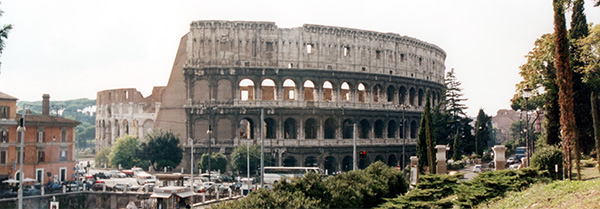
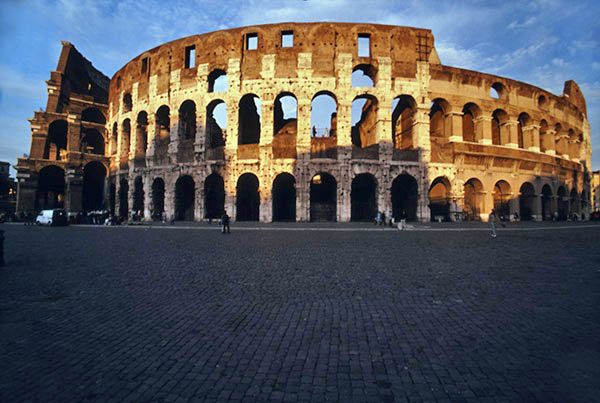
first thing I came upon was the colosseum (Flavian Ampthitheatre).
02) ROME | The
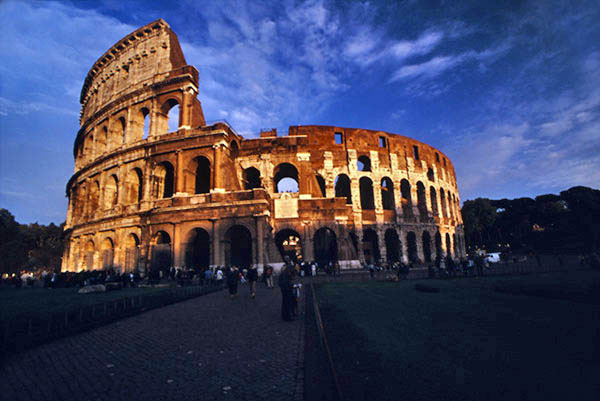
Flavian Ampthitheatre is the largest known amphiteatre of the Ancient
Roman empire - seating between 50-80,000 people (depending on which source
you read).
03) ROME | It
was started by the Emperor Vespation in 72 AD. The prior emperor - the
corrupt Nero - had his private villa here. In fact, the exact spot where
the amphitheatre now stands was a pond on Nero's estate. After Nero's
fall, Vespation had the pond drained for this "public" project.
04) ROME | The
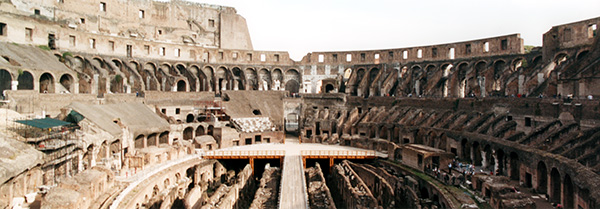
price of a ticket let me explore two levels. The very upper and lower
levels were restricted to the archaeologists.
05) ROME | Looking
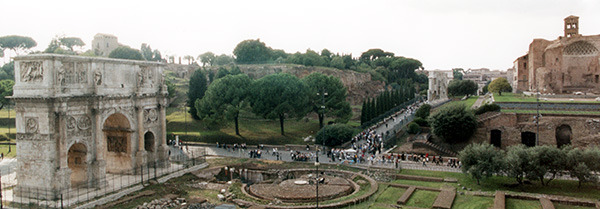
towards the Roman forum from one of the upper levels of the colosseum.
At the left is the Arch of Constantine. The Via Sacra leads into the photo
(and the forum). The Arch of Titus is located just where it crests the
hill. The Palatine hill rises in the upper left-hand portion of the photo.
06) ROME | It's
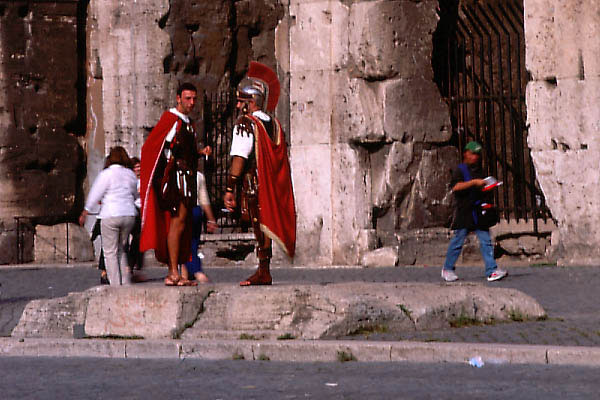
Russel Crowe - not!
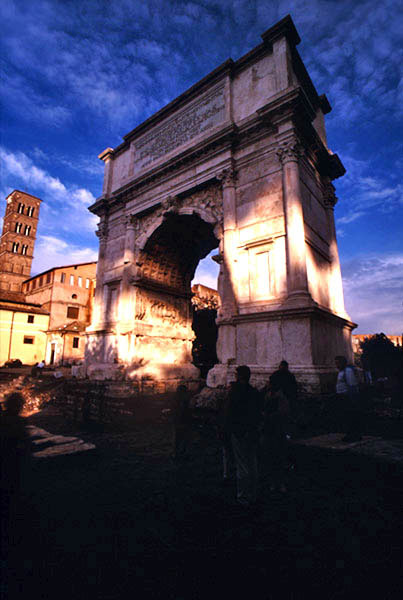
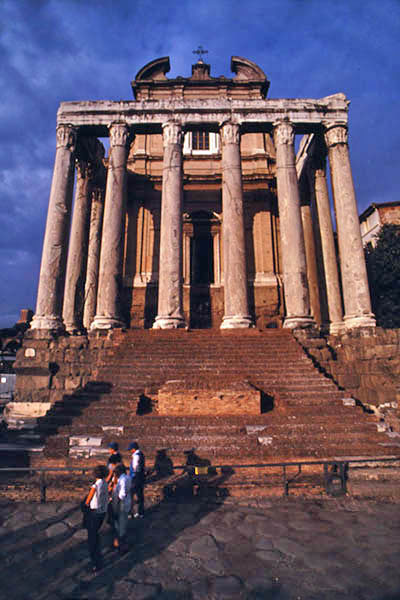 07) ROME | I was walking up the Via Sacra when I was stopped by a Australian girl. She was giving free tours of the Forum as part of a promotion for the tour company she worked for. As soon as she had enough people she took us through - which was great for me, as I had forgotten most of specifics of this place! For example, the building within the colonade is Chiesa di San Lorenzo which dates to the 8th century. The colonade is part of a much other temple that dates back to 141 AD. Look closely for the horizontal lines that appear just below the capitals. In the middle ages, people tied ropes around the columns in an attempt to pull them down. They failed because at that time, the street level was much higher and the column bases were actually buried. |
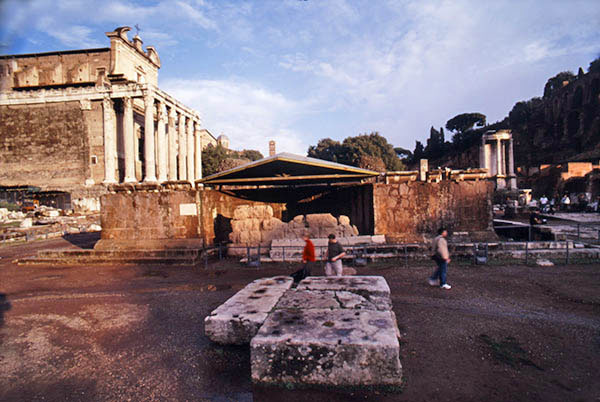
08) ROME | The
supposed resting place of Julius Caesar (the low-lying structure with
the roof). behind the partial wall is a mound of dirt upon which people
place flowers.
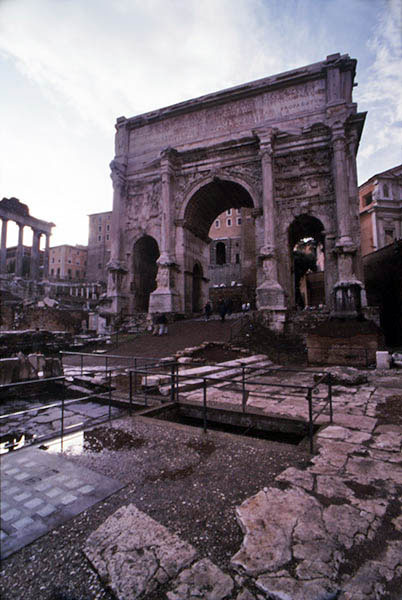 09) ROME | The Arch of Septimus Severus (203 AD). The retangular hole in the foreground is the entrance to the tomb of Romulus - founder of Rome. |
|
. |